History Chapter I
Bands, bodices and breast bags
Antiquity – 15th century
Long before anyone said “bra”, people bound, wrapped and supported the breasts. A Roman floor mosaic and a sealed room in an Austrian castle give us two of the clearest glimpses.
The story of the bra does not begin with an inventor. It begins with cloth — wrapped, tied and stitched by people whose names were never written down. Very little of it survives, because linen and wool rot. What we have instead are pictures, a few words in old texts and, every so often, a lucky find.
The women of the Villa del Casale
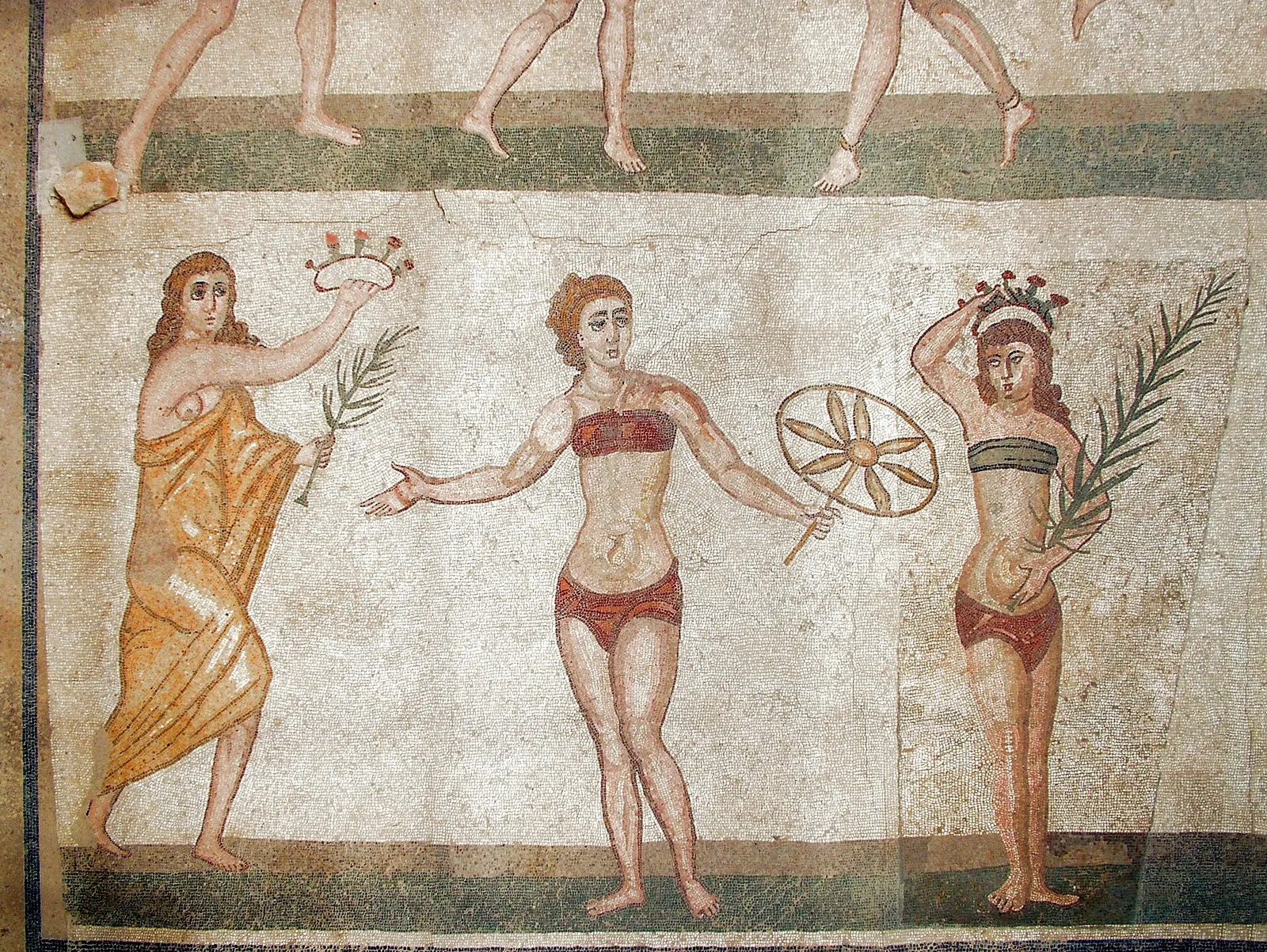
In the Roman villa of Casale, near Piazza Armerina in Sicily, a floor mosaic shows ten young women exercising. Nine wear what look, to modern eyes, like two-piece swimsuits. The villa dates to the early fourth century AD, and the scene has been nicknamed the “bikini girls” ever since.
The women are athletes, not bathers. One carries hand weights, another is about to throw a discus, others run, and two play a ball game. Writing for Ancient World Magazine, the archaeologist Josho Brouwers explains that the top is a breastband — the Romans called it a strophium — and the bottom a loincloth called a subligaculum.
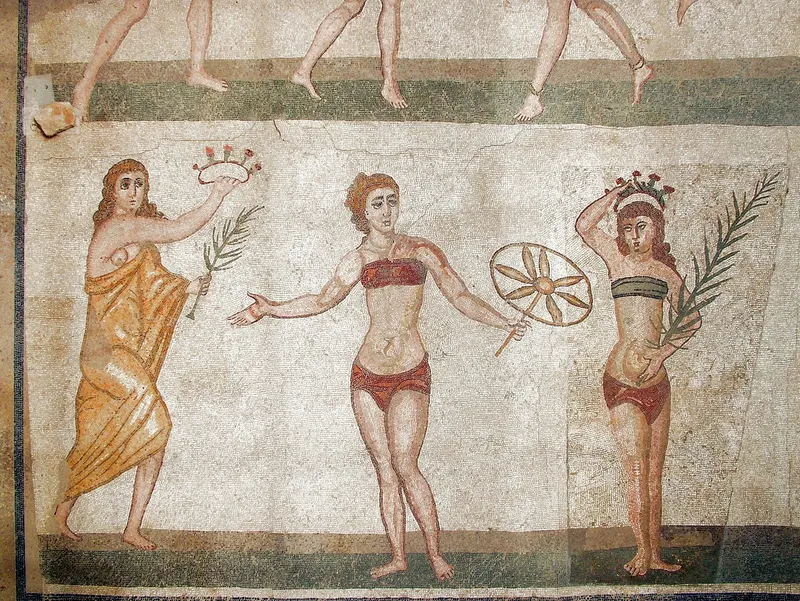
A band of cloth across the chest is about as simple as support can be: no cups, no fastening beyond a knot or a tuck. It flattens rather than shapes. But it already answers the question every later garment in this history tries to answer — how to hold the breasts steady while the body moves.
“Bags for the breasts”
For the next thousand years the record goes quiet. Medieval writers mention support only in passing. According to the University of Innsbruck, the written sources are vague: they refer to “bags for the breasts”, to “shirts with bags”, or to breast-bands used to bind down large breasts. Nobody knew what such garments actually looked like.
That changed in a castle in East Tyrol, Austria.
The Lengberg Castle finds
During rebuilding work at Lengberg Castle, archaeologists began excavating in July 2008. In the south wing they found a vault that had been filled with rubbish and sealed in the late fifteenth century. Dry conditions had preserved twigs, straw, worked wood, leather shoes — and more than 2,700 fragments of textile.
Among them were four linen garments that look remarkably like modern bras, with distinct, cut cups. Some were plainly made; others were decorated with needle lace. The archaeologist Beatrix Nutz of the University of Innsbruck studied them, and radiocarbon dating at ETH Zürich confirmed a fifteenth-century date.
Before Lengberg, there was nothing to show that bras with clearly visible cups existed before the nineteenth century.
The university put it plainly when it announced the discovery in 2012: until then, nothing indicated that bras with clearly shaped cups existed before the 1800s. The Lengberg garments push that idea back by several centuries.
What these early garments tell us
Two lessons run through the rest of this history. The first is that support and shaping are different jobs: the Roman band holds the breasts flat against the body, while the Lengberg linen shapes each breast in its own cup — the principle behind almost every modern bra.
The second is that “firsts” are slippery. Every time someone claims to have invented the bra, an older garment turns up. As the fashion historian Valerie Steele has put it, no one person invented the brassiere.