History Chapter IV
The brassiere arrives
1900 – 1929
Sheer blouses, active lives and a new word — “brassiere” — turned bust support into a separate garment. Patents multiplied, and department stores took notice.
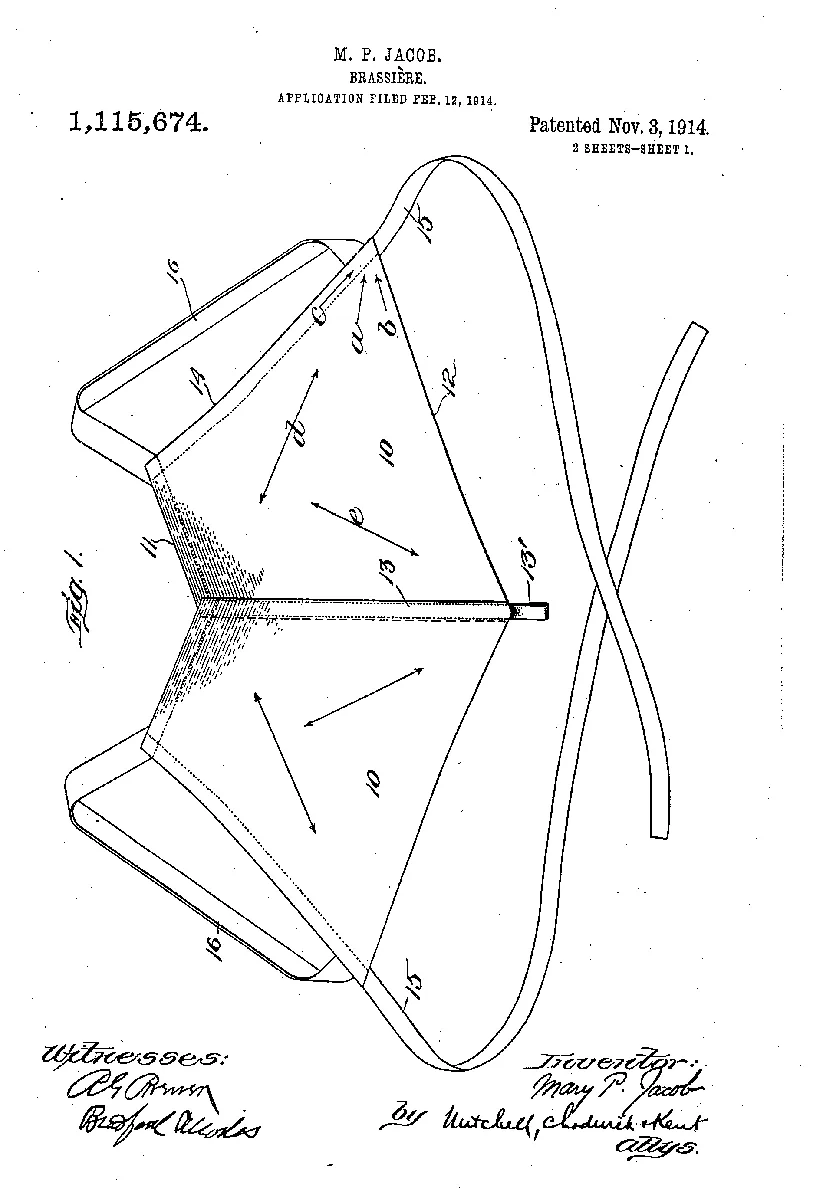
At the start of the twentieth century the fashionable “straight front” corset gave the bust less support than women were used to. According to the Underpinnings Museum, that is one reason various kinds of brassiere grew more popular: they were worn for modesty under increasingly sheer Edwardian blouses, and by dress reformers as an alternative to heavily boned corsets.
The word itself was new. The Online Etymology Dictionary dates “brassiere” in English to 1897, borrowed from the French brassière. The short form “bra” followed by 1923.
A patent for evening wear
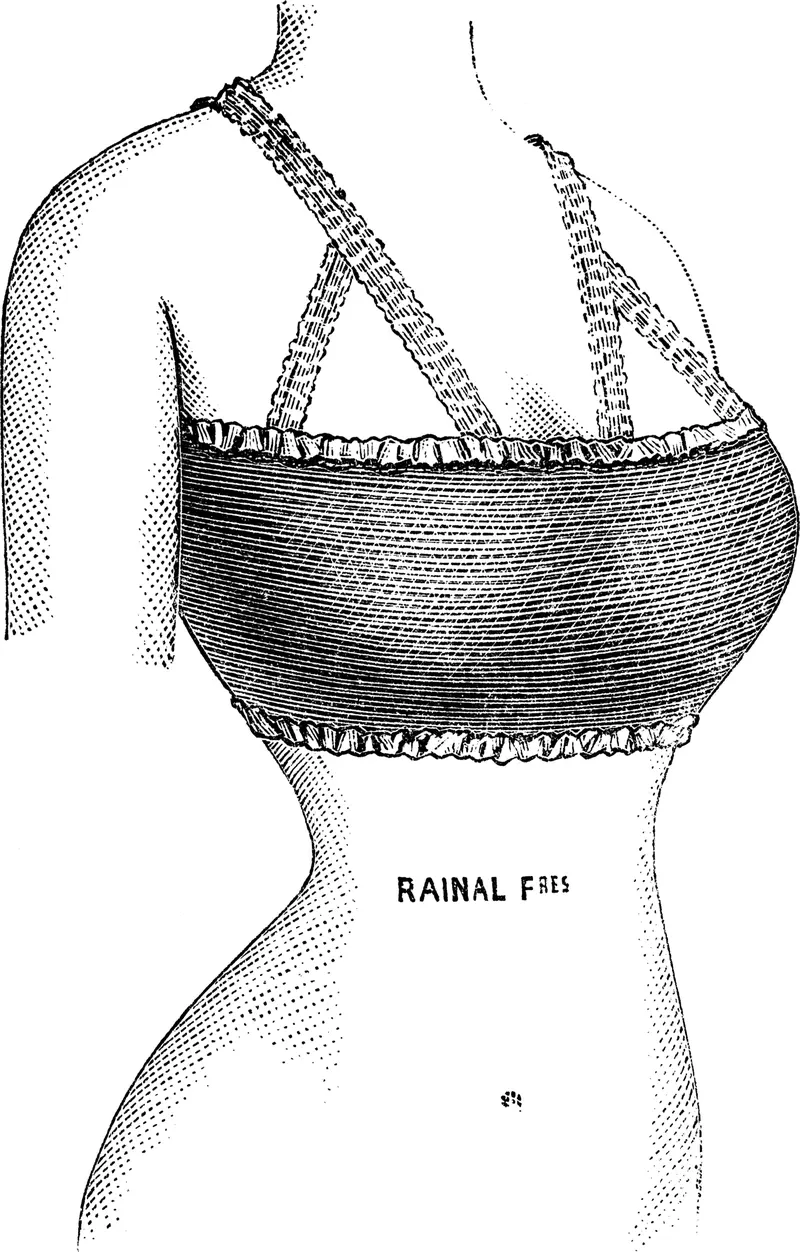
The best-known early patent belongs to Mary Phelps Jacob, later known as Caresse Crosby. Her application for a “Brassiere” was filed on 12 February 1914 and granted on 3 November 1914 as US patent 1,115,674.
The patent itself is modest. It describes a garment of the corset-cover type: two pieces of cloth cut on a slight bias and joined down the middle, with ties and a tape — preferably elastic — to hold it in place. Its point was practical. Earlier garments, the patent says, needed lacing across the back or sat so high that they spoiled evening gowns cut low at the back. Invention & Technology tells the often-repeated story that Jacob’s first version was sewn from two silk handkerchiefs and some ribbon.
It was not the first bust support, and it was soon one patent among many. In the 1920s, manufacturers registered a stream of patents for smoothing, supporting and — by the end of the decade — uplifting styles. The US firm Kops Brothers alone secured at least forty-one patents between 1904 and 1931.
A business, not a novelty
By the mid-1910s, the textile historians Jane Farrell-Beck and Colleen Gau write, brassieres rather than corsets had become the source of growing business in department stores’ foundation departments. More women worked and played outside the home, and they wanted less restrictive underwear.
Materials changed too. Viscose — first sold as “artificial silk” — was used widely for underwear in the 1920s and became known as rayon in 1925. Elastic began to appear in the backs of bras so they could move with the body.
Flattening the 1920s
The fashionable figure of the 1920s was boyish and straight, and many bras of the decade were bandeaux designed to flatten and streamline the bust. Two examples in the V&A show how they worked with the corset rather than replacing it: a black silk brassiere of about 1925 has a tab with an eye that hooks onto the corset, and a satin and lace one of about 1929 — a straight band with hook-and-eye fastening at the back — has elastic bands with hooks to attach it at the waist.
Two enduring names
In 1922, in Enid Bissett’s New York dress shop, Enid Frocks, Bissett and the seamstress Ida Rosenthal decided that the flat bandeaux of the day were spoiling the fit of their dresses. The Smithsonian’s Archives Center records that they gathered the bandeau in the middle for more support; Ida’s husband William added straps. They called the bras “Maidenform”, a counterpoint to a rival brand called “Boyish Form”. At first the bras were given away with dresses; demand grew until the business stopped making dresses altogether, and the first Maidenform factory opened in Bayonne, New Jersey, in 1925.
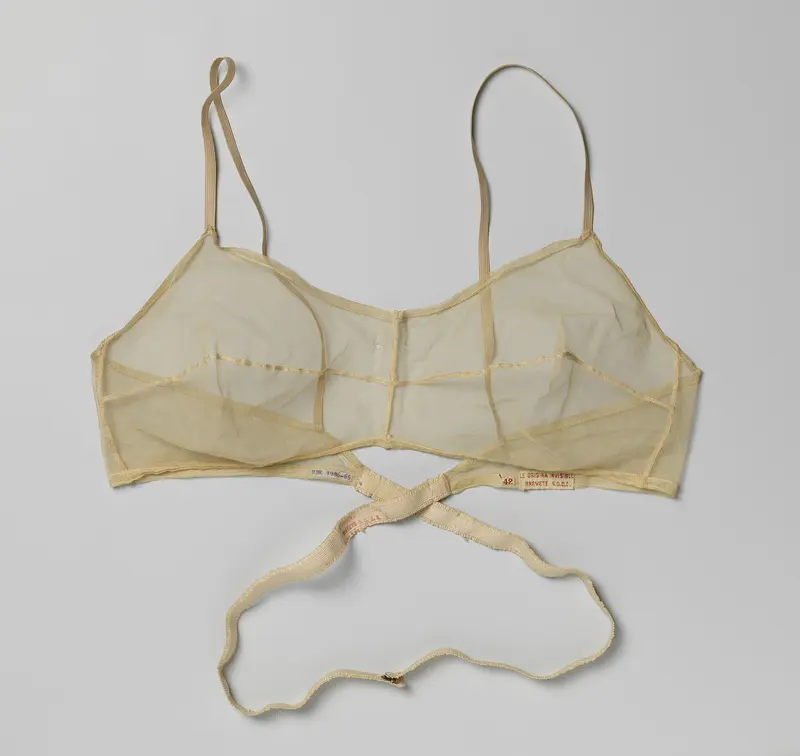
In London, Rosamond Lilian Klin designed the Kestos, patented in 1926 — two lightly darted triangular cups, with elasticated straps that crossed at the back and buttoned at the front. The Underpinnings Museum calls it arguably one of the first commercially produced bras with separate cups. The shape became so familiar that “a Kestos” became a name for the style itself.