History Chapter VI
War, rationing and the New Look
1939 – 1959
Nylon arrived and disappeared again; Britain rationed clothes; then Dior’s New Look demanded curves — and foundation garments to build them.
Nylon — briefly
DuPont introduced nylon in 1939, and it was first used by hosiery and bra makers in the United States, which had not yet entered the war. The Underpinnings Museum notes that by 1940 nylon lingerie was selling as fast as it could be made, even though it cost as much as pure silk. Nylon bras made from marquisette, taffeta and powernet were on sale in 1941 and 1942 — then withdrawn so that the fibre could go to the war effort.
Another fibre with a long future appeared in Lancashire: the Calico Printers Association in Accrington made the first test-tube filament of polyester in 1941.
Britain on the ration
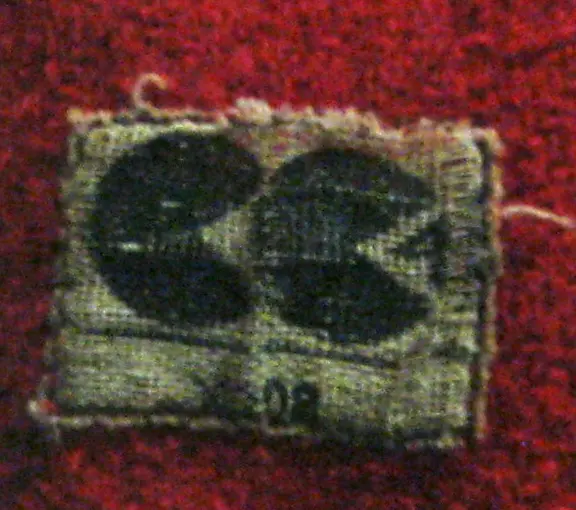
In Britain, clothes were rationed from 1 June 1941 until 1949. The Imperial War Museums explain that the government also stepped into mass-market clothing: from autumn 1941 all Utility cloth and garments had to carry the CC41 mark — often likened to two cheeses — designed by Reginald Shipp, and the first Utility clothes went on sale in 1942. Austerity rules banned many trimmings, and elastic was in very short supply throughout the war. The Utility scheme continued until 1952.
Bra makers turned to war work too. The Smithsonian records that Maidenform made silk parachutes and “pigeon vests”, which let paratroopers carry homing pigeons as they dropped behind enemy lines.
The New Look
In 1947 Christian Dior showed his “Corolle” line, nicknamed the New Look. Its full skirts were remarkable at a time of shortages — but it was the return of a curvy figure, with a small waist and full, lifted bust, that changed underwear. After the war, underwiring became more common and boned longline styles were popular; many New Look copies were designed to be worn over foundations that did the shaping.
Padding increased dramatically in the 1950s: foam rubber, felt or eiderdown built into the bra, pads that slipped into pockets, and separate “bust forms”. A strapless Kestos brassiere of about 1953 in the V&A shows the technology of the moment — boned, wired cups interlined with rubberised padding, a hook fastening at the front, and loops for optional straps.
Dreams and points
Advertising became an art form. Maidenform’s “I Dreamed” campaign launched in 1949 and ran for twenty years — one of the longest-running campaigns in advertising history, according to the Smithsonian.
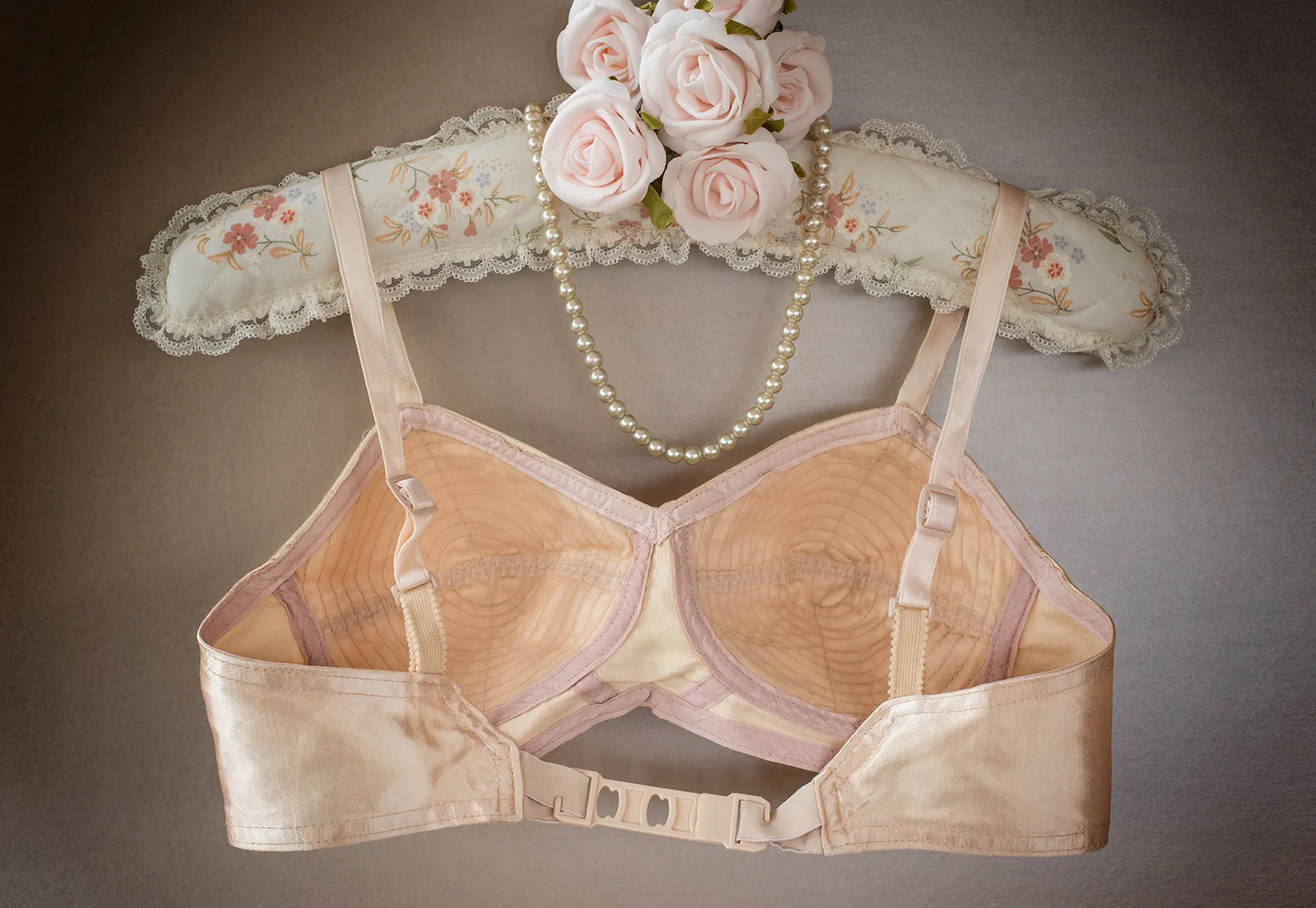
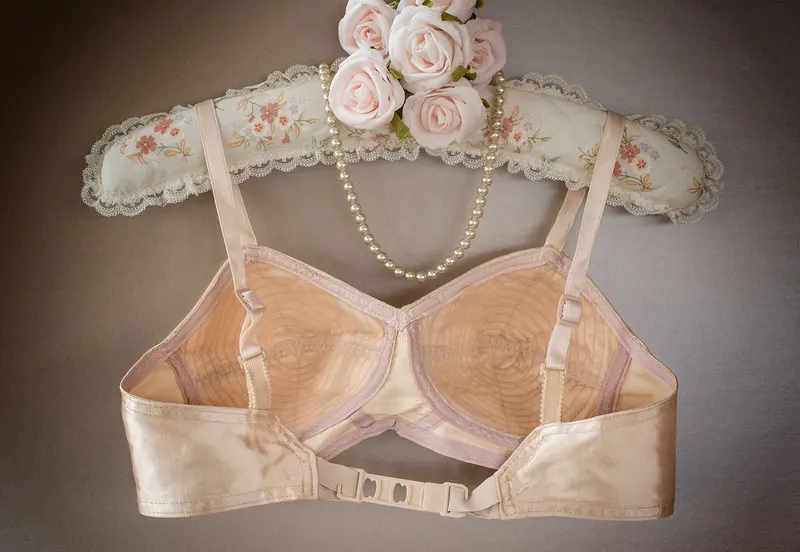
The pointed silhouette of the period owed a lot to stitching. Concentric rings of stitching on the cups — the technique behind 1930s “Whirlpool” stitching — produced the pointed cups of the 1940s and 1950s, often nicknamed “bullet bras” today. At the end of the decade a new process, pre-forming, moulded and lined cups into a rigid, structured shape.
In Britain the R. & W. H. Symington factory in Leicestershire won the licence to make ready-to-wear Christian Dior lingerie in 1957, sold through stores such as Harrods and Selfridges.